
Blog
Quick Answer
Breathing training for hiking conditions the muscles that do the actual work of getting oxygen into your body at altitude. Strong legs get most of the training time before a big trek, but above 2,500 metres, it is often your breathing, not your legs, that decides how the climb feels.
Most people training for a big trek spend months on their legs. Hill sessions, weighted pack walks, endless stairs. Barely a thought goes to the muscles doing the actual work of getting oxygen into the body.
Then they hit 3,000 metres and wonder why every step feels like wading through wet sand. Strong legs matter, but at altitude, breathing is often the real limiting factor. It is also one of the few parts of trekking fitness most people never train at all.
Why Trekking Fitness Needs to Include Your Lungs
Thinner air at altitude means every breath delivers less oxygen, so the muscles responsible for breathing work considerably harder just to keep up, long before the legs become the problem.
When those muscles fatigue, a few things happen. Breathing becomes shallower and less efficient. More blood gets diverted toward the effort of breathing itself rather than the legs. Everything from a gentle uphill to a rocky scramble starts to feel disproportionately hard.
This is exactly the gap that breathing training for hiking is designed to close, conditioning the muscles that will be under the most unusual strain of the entire trip.
What Happens to Your Breathing at Altitude
As altitude increases, lower air pressure means each breath contains fewer oxygen molecules. The body compensates by breathing faster and deeper, a response known as hypoxic hyperventilation.
This extra respiratory workload, sustained hour after hour on the trail, is a major contributor to the fatigue and breathlessness trekkers describe well before they would expect to be tired. The diaphragm and the muscles between the ribs are doing dramatically more work than they do at sea level, and like any muscle group under sustained load, they benefit from being conditioned in advance.
What the Research Says About Altitude Breathing Exercises
This is not just theory. Researchers put a group of trekkers on an 11-day route to Everest Base Camp after a seven-week inspiratory muscle training programme and compared them against a placebo group using the same device at a much lower resistance.
| Study | Altitude | Training period | Groups | Key finding |
|---|---|---|---|---|
| Everest Base Camp trek | 5,300m | 7 weeks before an 11-day trek | Trained vs. low-resistance placebo | Measured oxygen saturation and perceived effort and breathlessness during the trek |
| Nepali Himalaya expedition | Up to 5,550m | 4 weeks before departure | 14 climbers, trained vs. untrained | +15% maximal inspiratory pressure; higher resting oxygen saturation as altitude increased |
Study snapshot — Everest Base Camp trek, 5,300m. A 7-week inspiratory muscle training programme, using a handheld resistance device, was compared against a low-resistance placebo group ahead of an 11-day trek. Seims, A., O'Hara, J., King, R. & Cooke, C.B. (2014). Inspiratory muscle training and its effect on oxygen saturation and perceptions of effort and dyspnoea during a trek to Everest base camp. High Altitude Medicine & Biology, 15(2). Leeds Beckett Repository ↗
A separate study followed a military climbing expedition into the Nepali Himalaya, training one group with inspiratory muscle training for four weeks before departure and leaving a control group untrained. Resting blood oxygen was tracked from sea level up to 5,550 metres.
15%
increase in maximal inspiratory pressure after four weeks of training, in a 14-climber Nepali Himalaya expedition study that tracked resting blood oxygen up to 5,550m — the trained group held higher resting oxygen saturation as altitude increased. PubMed ↗
"Trained breathing does not always translate into a faster finish time. What it consistently changes is how much easier the whole climb feels." — On the effect of inspiratory muscle training at altitude
That last point matters enormously on a multi-day trek where energy management, not raw speed, is what gets a person to base camp feeling capable rather than depleted.
Train both directions of the breath. The Breather Fit trains the inhale and the exhale, closely matching the resistance protocols used in the altitude studies above rather than working one direction only. See The Breather Fit
Building a Breathing Training Routine Before Your Trip
Most of the studies behind these results used a straightforward setup. Several sets of resisted breaths, a handful of times a week, for around four to six weeks before departure. Nothing elaborate is needed to follow the same principle.
8–6 weeks out: Start resistance-based inspiratory training three to four times a week, a few minutes per session. This is a good time to introduce The Breather Fit into a regular training routine, since it is built for exactly this kind of performance-focused, dual-direction resistance work.
4–2 weeks out: Keep sessions consistent and pair them with hill or stair training, so the legs and the breathing muscles are conditioned together rather than separately.
Trip week: Taper training slightly, the same way leg fitness gets tapered, so the body arrives rested rather than fatigued.
On the trail: Short sessions before a big ascent day can help, though the main work is already done in the weeks beforehand.
Trekking Lung Preparation Is Not a Substitute for Acclimatisation
This is worth being direct about. Breathing training improves how efficiently the muscles handle the workload of breathing at altitude. It does not replace proper acclimatisation, gradual ascent profiles, hydration, or medical advice before a high-altitude trip.
Before you go. Altitude sickness is a genuine medical risk above roughly 2,500 metres, and no amount of breathing training changes that. It can affect fit, experienced trekkers as easily as anyone else. Speak to a doctor or travel health clinic before any serious high-altitude trek, particularly with a history of altitude illness or an existing respiratory condition. Healthdirect Australia has a good overview of symptoms and when to seek help.
Every serious trekker trains their legs. Very few train the muscles that will actually be gasping for air at 4,000 metres. A few minutes a day for a few weeks before departure is a small habit that changes how the whole climb feels.
Frequently Asked Questions
How soon before a trek should I start breathing training for hiking?
Most research protocols run for four to six weeks before departure, training three to four times a week for a few minutes per session. That gives your inspiratory muscles enough time to adapt before you need them on the trail.
Will altitude breathing exercises prevent altitude sickness?
No. Breathing training conditions the muscles that do the work of breathing, but it does not replace gradual ascent, hydration, or medical advice. Altitude sickness is a genuine medical risk above roughly 2,500 metres regardless of how fit your lungs are.
What is inspiratory muscle training?
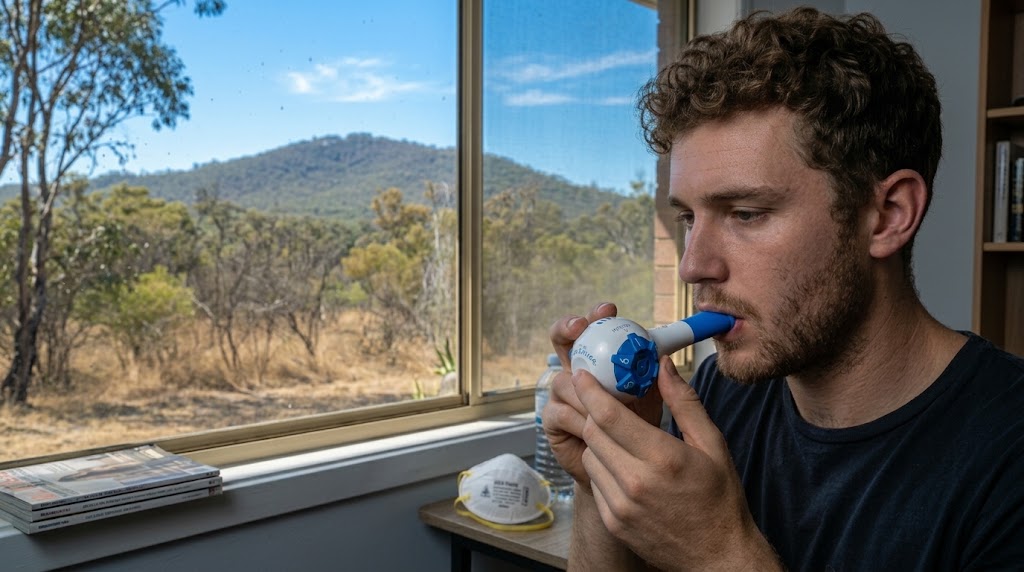
Inspiratory muscle training, or IMT, uses a handheld resistance device to load the diaphragm and the muscles between the ribs, the same way a weight loads a bicep. Trekkers typically train against resistance for a few minutes, several times a week, in the weeks before a high-altitude trip.
Can I do breathing training alongside my normal leg and hill training?
Yes. Most trekkers pair short IMT sessions with their existing hill, stair, or pack-walk training rather than treating it as a separate program. The two systems, legs and lungs, are best conditioned together in the weeks before departure.
Related Posts